How to play BeamNG.drive on Mac with force feedback (CrossOver + Torqer)
BeamNG.drive runs very well on Apple Silicon Macs through CrossOver, and Torqer can restore real force feedback on compatible wheels. That matters more in BeamNG than in most driving games, because the whole point is physics: weight transfer, front-end scrub, suspension loading, the moment the car starts to lose grip… and of course: crashes 🙂
This guide covers the setup that matters if you want BeamNG on Mac with working FFB.
What you’ll need
- A Mac with Apple Silicon (M-series) running macOS 13 or later
- A Torqer-supported wheel like Logitech G29, G27, Cammus C5, Moza R5, Fanatec CSL DD, etc.
- CrossOver
- Torqer — free download, includes a 5-day full-feature trial
- A Steam copy of BeamNG.drive (Steam is the tested storefront for this setup. Other PC versions may also work through CrossOver, but we have not verified them yet)
Step 1 – Prepare your Mac
1a. Remove vendor/driver software if installed
Driver software like Logitech G Hub can conflict with Torqer’s direct hardware access. If such software is installed, we recommend you remove it before continuing.
For Logitech G Hub specifically: Open G Hub and use its uninstall flow, or drag it from /Applications to the Trash and remove its launch agent:
sudo rm /Library/LaunchAgents/com.logi.ghub.engine.plist1b. Install CrossOver
- Download CrossOver from codeweavers.com
- Drag it to
/Applications - Launch it
1c. Create a Windows 10 64-bit bottle
- In CrossOver, click New Bottle
- Create a Windows 10 64-bit bottle
- Name it something like
BeamNGorSteam
Open the bottle settings and enable:
- D3DMetal
- MSync
- If you’re using CrossOver 26 or newer, you can usually leave DLSS enabled as well.
This is the verified working baseline for BeamNG in Torqer’s compatibility testing.
Step 2 – Install Steam and BeamNG.drive
- Select the bottle in CrossOver
- Click Install Software
- Search for Steam and install it
- Log into Steam
- Install BeamNG.drive
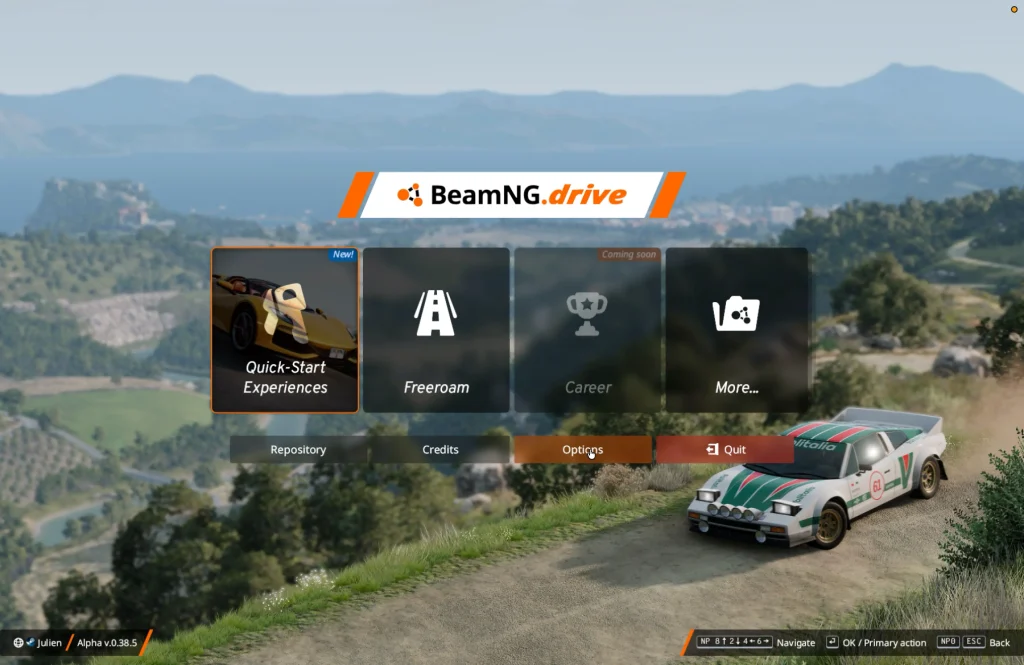
When installation finishes, launch BeamNG once to confirm it reaches the menus, then close it again.
Tip: Enable macOS Game Mode before launching. It helps reduce background CPU and GPU load, which can improve frame pacing in CrossOver. Guide: How to enable Game Mode on Mac for CrossOver and Wine games
Step 3 – Install Torqer and enable FFB
3a. Download and install Torqer
Download Torqer, open the DMG, and drag Torqer to your Applications folder.
Launch Torqer. On first launch it starts a 5-day full-feature trial automatically.
3b. Connect your wheel
Plug in your wheel via USB if needed. Torqer should detect it automatically and show a green connected state.
3c. Install Torqer into your CrossOver bottle
- In Torqer, click Install FFB
- Select your BeamNG bottle
- Click Install
This installs Torqer’s DirectInput wrapper into the bottle so BeamNG’s native force feedback signal can reach the wheel.
3d. Select BeamNG in Torqer
In Torqer’s sidebar, click BeamNG.
BeamNG currently uses Native FFB in Torqer. That is the supported path at the moment.
Step 4 – Configure the wheel in BeamNG
Launch BeamNG through CrossOver and go to the controls menu.
Make sure the game is using your wheel profile, then confirm or bind:
- Steering
- Throttle
- Brake
- Clutch if applicable
- Shifter or paddles if used
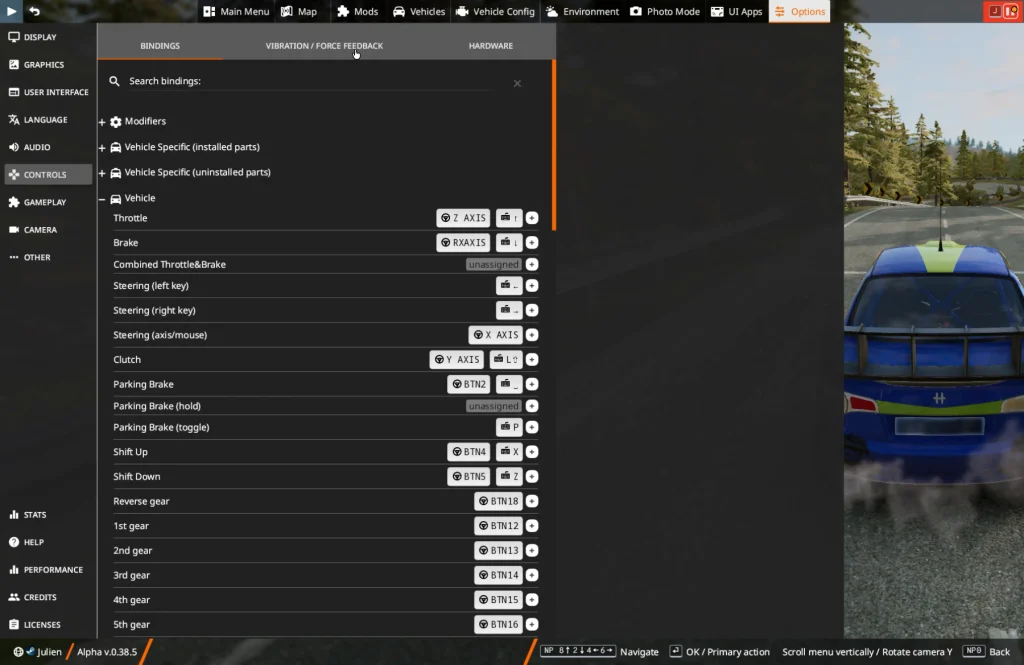
Before you leave the controls setup, open BeamNG’s Vibration / Force Feedback settings and make sure your wheel’s steering axis is selected as the force feedback axis. If the wrong axis is assigned there, the wheel can be detected correctly but still have weak or missing FFB:
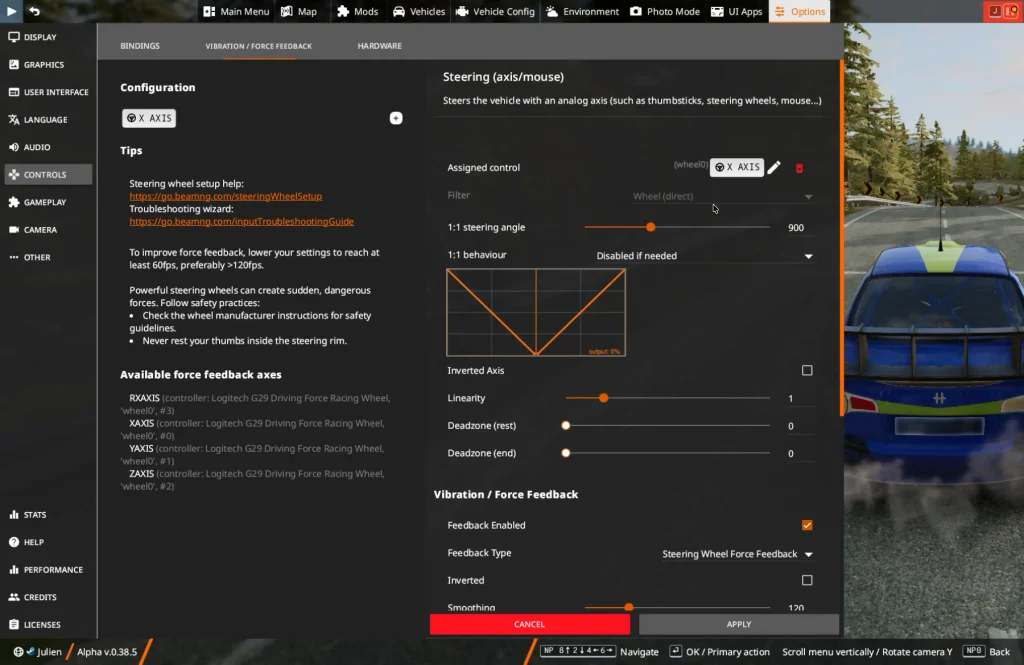
Then open BeamNG’s force feedback settings and start with sensible values rather than maxing everything immediately.
Good starting points:
- Overall strength: 70–100%
- Smoothing: low
- Response correction / filtering: low to moderate
- Extra vibration or canned effects: low
BeamNG feels best when the main steering forces are clear and direct. Too much smoothing or too many extra effects can make the wheel feel vague.
If the wheel feels too light after setting the in-game strength, increase Native FFB Intensity on Torqer’s BeamNG page.
Step 5 – Drive and fine-tune
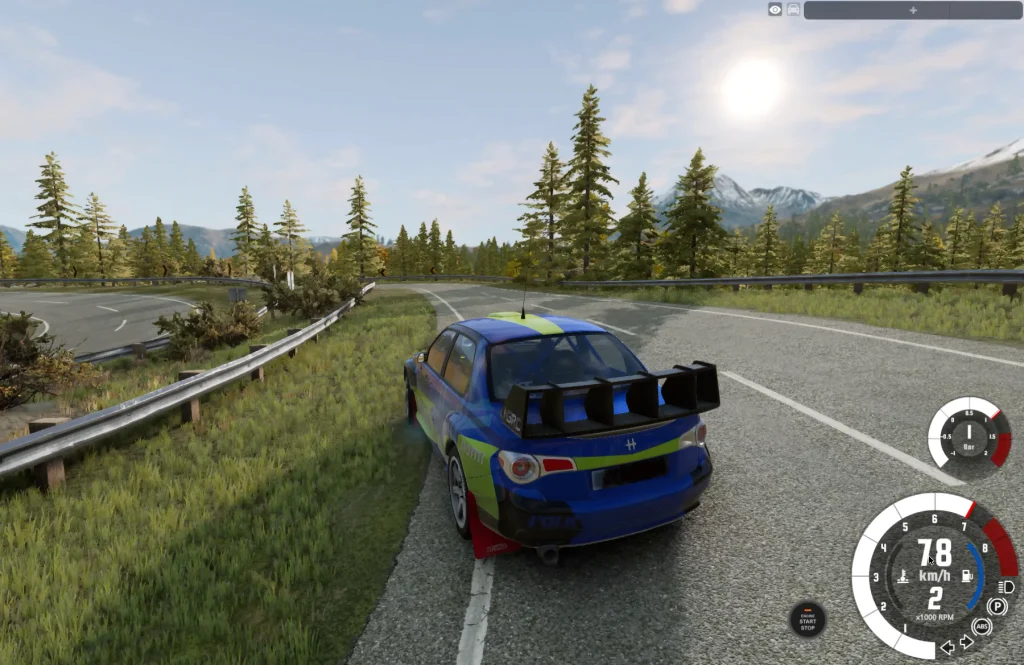
Once Torqer is running and installed in the correct bottle, BeamNG is one of the more satisfying Mac setups because the underlying vehicle physics are so detailed.
Use the first test drive to tune three things:
- low-speed steering weight
- front-end feel during cornering
- how sharply the wheel reacts over bumps and impacts
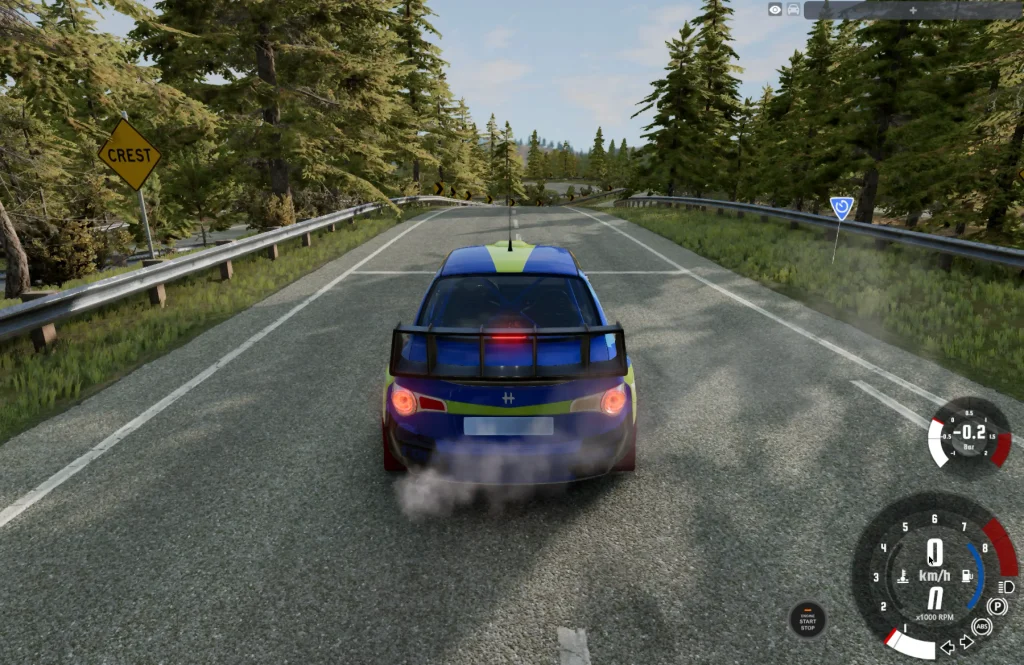
If the wheel feels too numb:
- lower smoothing in BeamNG
- raise BeamNG’s overall strength slightly
- then raise Native FFB Intensity in Torqer
If the wheel feels harsh or chatters too much:
- lower the in-game strength a bit
- reduce any extra vibration-style effects
- keep Torqer’s intensity reasonable instead of pushing both systems too hard at once
BeamNG is especially sensitive to over-filtering. Cleaner settings usually feel better than heavier ones.
Troubleshooting
The wheel steers, but there is no force feedback
Make sure Torqer is running before BeamNG launches, the wheel shows as connected in Torqer, and the FFB wrapper is installed in the same bottle where BeamNG is installed.
The game detects the wheel, but the feel is weak
Raise BeamNG’s main FFB strength first, then raise Native FFB Intensity in Torqer for BeamNG.
The wheel feels vague or rubbery
Lower smoothing and filtering in BeamNG. Over-smoothing hides exactly the kind of physics detail that makes BeamNG interesting on a wheel.
Performance is inconsistent
Confirm D3DMetal and MSync are enabled in the bottle settings, then enable macOS Game Mode as well: How to enable Game Mode on Mac for CrossOver and Wine games
Nothing works at all
Check that Logitech G Hub is not installed, Torqer sees the wheel as connected, and BeamNG is in the same CrossOver bottle where Torqer FFB was installed.
Tested configuration
Steam bottle on CrossOver 25.1.1 and 26.1.0 · Windows 10 64-bit bottle · D3DMetal + MSync · Apple Silicon MacBook Pro M4 Pro · Logitech wheel via Torqer
If you run into something not covered here, you can contact us.